
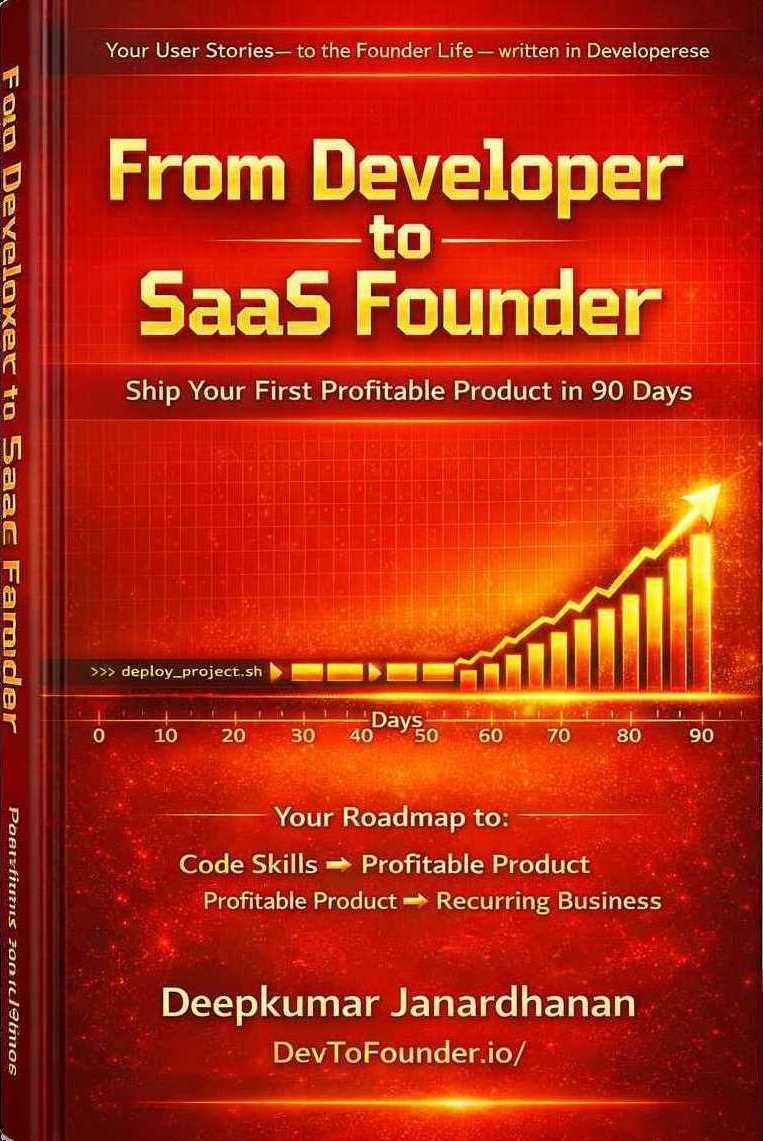

After years inside SaaS execution environments, one pattern kept repeating:
Brilliant developers would build technically sound products that never
generated
revenue.
❌ Not because they lacked skill.
❌ But because they approached product creation like engineering —
instead of like capital allocation.
🟠 Validation came after code.
🟠 Pricing came after launch.
🟠 Distribution came last.
The result:
🛑 Months of effort.
🛑 No signal.
🛑 Eroded confidence.


In small SaaS businesses, being technical is not just a skill. It is leverage.
Most founders move at the speed of contractors. You move at the speed of implementation.
The difference compounds.
Customers feel heard.
Feedback loops tighten.
Your product evolves faster than competitors can respond.
Speed compounds into reputation.
Reputation compounds into revenue.
That means:
✔️ Higher margins
✔️ Lower break-even point
✔️ Ability to serve smaller, profitable niches
✔️ Freedom to reinvest faster
Same revenue. Significantly more retained profit.
🟢 Deep integrations.
🟢 Custom automation.
🟢 Enterprise-ready features.
What costs a competitor $7,000 and 10 weeks might cost you a weekend.
Non-technical competitors often cannot afford to build them.
Most developer-led products fail because of overengineering — not underengineering.
🟠 Kubernetes for five users.
🟠 Mobile apps before revenue.
🟠 Perfect refactors before validation.
✔️ Build for 10 users.
✔️ Optimize at 100.
✔️ Scale at 1,000.
Revenue validates architecture. Not the other way around.
You do not lack technical capability.
What most senior developers lack is a disciplined way to direct that capability toward revenue.
This book shows you how to convert technical speed into a revenue-generating asset in 90 structured days.

Most senior developers don’t fail because they lack ability. They fail because they misapply their advantage.
✔️ You can ship production systems.
✔️ You can debug distributed failures.
✔️ You can implement complex integrations in hours.
The issue is not capability. The issue is sequence.
When speed is applied in the wrong order, it produces code — not revenue.
When speed is applied correctly, it becomes leverage.


That moment changes how you see your skillset.
And your self-worth!
This book is engineered to get you there — deliberately.

Most developers approach product creation the same way they approach engineering:
1. Define requirements.
2. Build cleanly.
3.Iterate.
That works inside a company. ❌ It fails when you are responsible for revenue.❌
Revenue does not emerge from code quality. It emerges from decision sequencing.
Specifically:
When those decisions are made in the wrong order, technically sound products generate no commercial signal.
After observing repeated developer-led product attempts, a clear progression becomes visible.
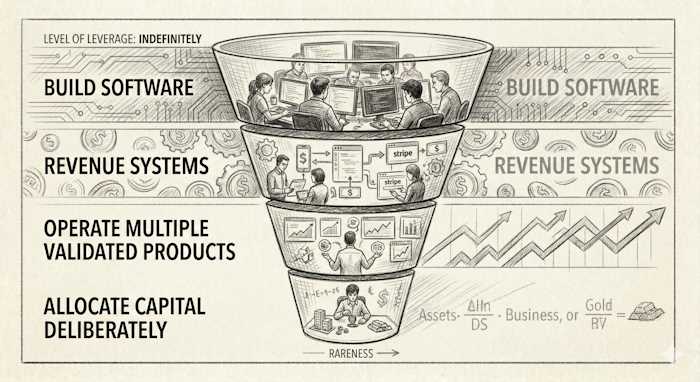
Most technically capable engineers operate indefinitely at one level of leverage: they build software.
A smaller group learns to build revenue systems.
An even smaller group learns to operate multiple validated products.
And a rare few learn to allocate capital across those assets deliberately.
That progression is predictable.👇
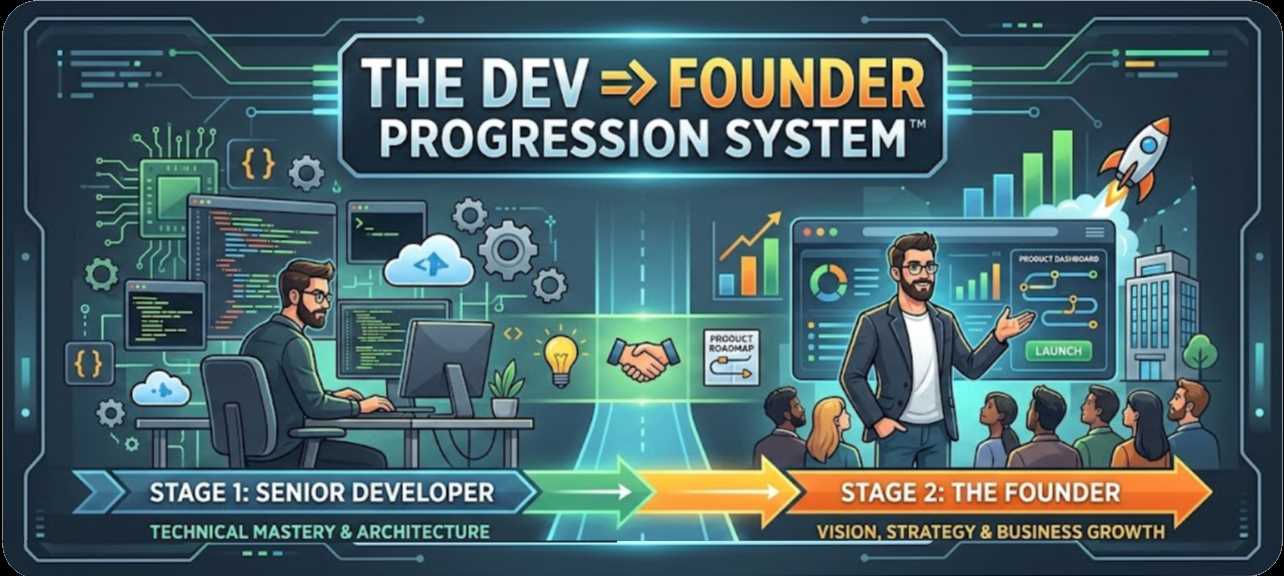
The Systems Builder stage of The Dev => Founder Progression System™ is a hardcore operations manual- offering a Structured path to scalable SaaS ownership.
This book operationalizes this stage in 90 days.
Manages multiple validated products. Compounds revenue.
Allocates capital strategically. Builds scalable assets.
Most developers remain in Stage 1.
This book is engineered to transition you deliberately into Stage 2.
Not through inspiration.
Through constraint.

Transitioning from Software Creator to Systems Builder is not a mindset shift. It is a decision architecture shift.
Stage 2 is operationalized through a constrained selection and execution engine.
Before development begins, every idea must pass a structured filter.
Most developers start with an idea.
Systems builders start with constraints.
Before a single line of code is written, your product must pass five enforced gates. 5
If the problem is vague, the product will be vague.
“Improve developer productivity.”
“Help solo Shopify store owners reconcile Stripe disputes in under 10 minutes.”
Specific pain converts. General ambition doesn’t.
If you cannot clearly describe the buyer, you cannot reach them.
No persona clarity → no build.
Most developers build first and think about traffic later. This framework reverses that order.
If distribution is unclear, development does not begin.
Scope must fit inside a 30-day solo build window.
Constraint creates shipping.
The product must generate revenue with:
If it requires scale to survive, it is not a microproduct. It is a startup.
Problem Identified:
Independent property managers spend 3–5 hours per month manually reconciling tenant
utility
overages.
Persona:
Small US-based property managers with 5–30 units.
Distribution Identified Before Build:
Facebook groups + direct outreach via public rental listings.
Build Scope (≤ 30 Days):
Price:
$39/month
Result at 90 Days:
12 paying customers → $468 MRR
No ads. No funding. No team.
Most developer-led products fail at Gate 2.
They choose problems they personally find interesting — not problems a defined group is already paying to solve.
The selection engine - detailed in this book- exists to prevent that mistake before it becomes a 6-month detour.
This is not a motivational sprint. It is a structured execution sequence.
Each phase builds leverage. Each phase has a defined output.
Goal: Evidence that someone will pay. Not assumptions.
Build for 10 users. Not 10,000.
Revenue signal matters more than upvotes.
Momentum compounds.
By Day 90, you will know whether to scale, iterate, or kill the idea — without guesswork.
This 90-day structure is not about speed.
It is about disciplined execution within constrained scope — the foundation of the Systems Builder stage.
❌ Not a pitch deck.
❌ Not a half-finished side project.
❌ Not another abandoned GitHub repository.
By Day 90, you will have one of two outcomes:
Not hypothetical validation.
Actual signal.
If an idea fails inside this system,
it fails quickly and cheaply.
That clarity is leverage.
The real shift is not from DEVELOPER to “startup FOUNDER.”
The shift is from:
Whether the first product succeeds or fails,
you will leave 90 days with a REPEATABLE EXECUTION DISCIPLINE.

If you are looking for inspiration, shortcuts, or venture-funded growth tactics, this is not designed for that objective.
The 90-day structure assumes a full-time job. Most execution is 10–12 focused hours per week.
The issue is rarely time. It is unstructured effort.
Broad markets are saturated. Narrow pain points are not.
The framework forces you into constrained, specific problems — not generic SaaS categories.
Most developer-led attempts fail for predictable reasons: overengineering, delayed charging, or no distribution.
This system changes the order of operations.
Failure inside a 90-day constraint is controlled. Failure inside a 12-month side project is expensive.
Fast feedback is leverage.
AI lowers implementation cost. It does not eliminate the need for validation, distribution, or pricing discipline.
Execution speed still compounds.
Ideas are not moats. Speed, integrations, and customer relationships are.
By the time a competitor copies you, you should already be iterating.
This is not a guarantee of success.
It is a guarantee of structured execution.
For most senior developers, that is the missing piece.

I've been a developer, technical lead, product manager, and an engineering leader for 30 years.
Check out my profile at  .
.
I am the Founder and Chief Executive at Cerebral Ops, where I lead product, engineering, delivery, and commercial operations across startups in the $5M–$50M range across the US, UK, EU, ANZ, and India.
When startups stall, misfire, or struggle to execute,
I am brought in to diagnose what went wrong —
and rebuild the execution layer.
And help founders move from technical chaos to operational
clarity.
More importantly, I have created and marketed multiple Micro-Products; some that were successful, some that failed miserably. And that experience is what led me to write this book!
Across dozens of engagements, one pattern kept repeating:
Intelligence is rarely the issue. Technical capability is NEVER the issue.
Sequence is the issue.
✔️ I have seen what works.
🚩 I have seen what is doomed from the first sprint.
This book distills those observations into a disciplined, 90-day execution sequence designed specifically for technically capable builders.
It exists to prevent the avoidable failures I see repeatedly in SaaS execution.
Most developer side-projects fail before they ever reach customers. Not because developers cannot build — but because they build the wrong things in the wrong order.
In this opening section you will discover why most side-projects die:
You will learn how successful SaaS founders reverse this process — starting with the market, validating demand quickly, and only then writing code.
By the end of the introduction you will understand the core philosophy of this book: shipping a real, revenue-generating micro-product in 90 days.
Most developers start with code. Successful founders start with markets and problems.
This chapter explains why building first and searching for customers later is the fastest way to waste months of effort.
You will learn how profitable SaaS founders think differently:
By the end of this chapter you will have a new mental model for building SaaS products — one that dramatically increases the probability that what you build will actually sell.
Developers love elegant architectures. Customers simply want their problem solved.
This chapter explains why over-engineering is one of the biggest reasons developer side-projects never launch.
You will learn how to:
Your first version does not need to be beautiful. It needs to solve a problem well enough that someone is willing to pay for it.
Most developers dramatically underprice their products. They price based on effort instead of value.
This chapter breaks down how pricing actually works in SaaS and why correct pricing can transform the economics of your product.
Inside this chapter you will learn how to:
Pricing is one of the most powerful levers in SaaS. Small changes in pricing can dramatically increase revenue and improve the quality of your customer base.
One of the biggest myths in technology is: "Build it and they will come."
Successful founders build distribution at the same time they build their product.
This chapter explains how to start building an audience while you are still developing the product.
You will learn how to:
Distribution compounds over time. The audience you build today becomes the launch engine for every product you build tomorrow.
Launching is exciting, but real success comes from traction. This chapter focuses on the difficult phase between launch and sustainable recurring revenue.
You will learn how to:
The milestone for this stage is reaching roughly $5K MRR — the point where your product becomes a real business rather than just a side project.
Throughout this book you encounter real examples from founders who have built successful bootstrapped SaaS businesses.
These are not fictional stories or theoretical frameworks. They are real builders who have openly shared their journeys, revenue numbers, failures, and lessons learned.
This appendix collects links and references so you can explore their work in more depth and learn directly from their experiences.
Studying these founders will help you understand how real products are validated, launched, and grown without venture capital or large teams.
Many developers begin their founder journey while still working a full-time job. In some jurisdictions and companies, employment contracts restrict outside projects or “moonlighting”.
This appendix explores the practical and legal realities of building a side project while employed and the precautions you may need to take.
Several possible paths are discussed depending on your contract and risk tolerance:
The safest path is often to build with full transparency after leaving employment, but this appendix provides strategies to help founders evaluate their options and reduce risk while starting their journey.
The book is the core of the system, but it is only the beginning. Depending on the edition you choose, you will get access to a variety of templates, worksheets, and resources that complement the book's content and help you implement the strategies and tactics outlined in the chapters.
These assets are designed to provide practical support as you navigate the journey of building and launching your SaaS product, ensuring that you have the necessary resources to execute the system effectively and achieve your goals.
This is not a “read it once and decide” book.
It is a 90-day execution sequence.
You have a full 90 days to apply it properly.
If you follow the validation framework, attempt structured outreach, build the constrained MVP, and genuinely apply the system — and conclude it did not create clarity, signal, or commercial direction — request a refund.
No friction. No justification required.
Most guarantees protect buyers.
This one also protects your disciplined execution.
If the system does not improve how you execute, you keep your money.
This is an operational system for turning technical capability into controlled, compounding software assets.
The core framework remains the same. The difference is depth of implementation support.
For independent builders who want the playbook.
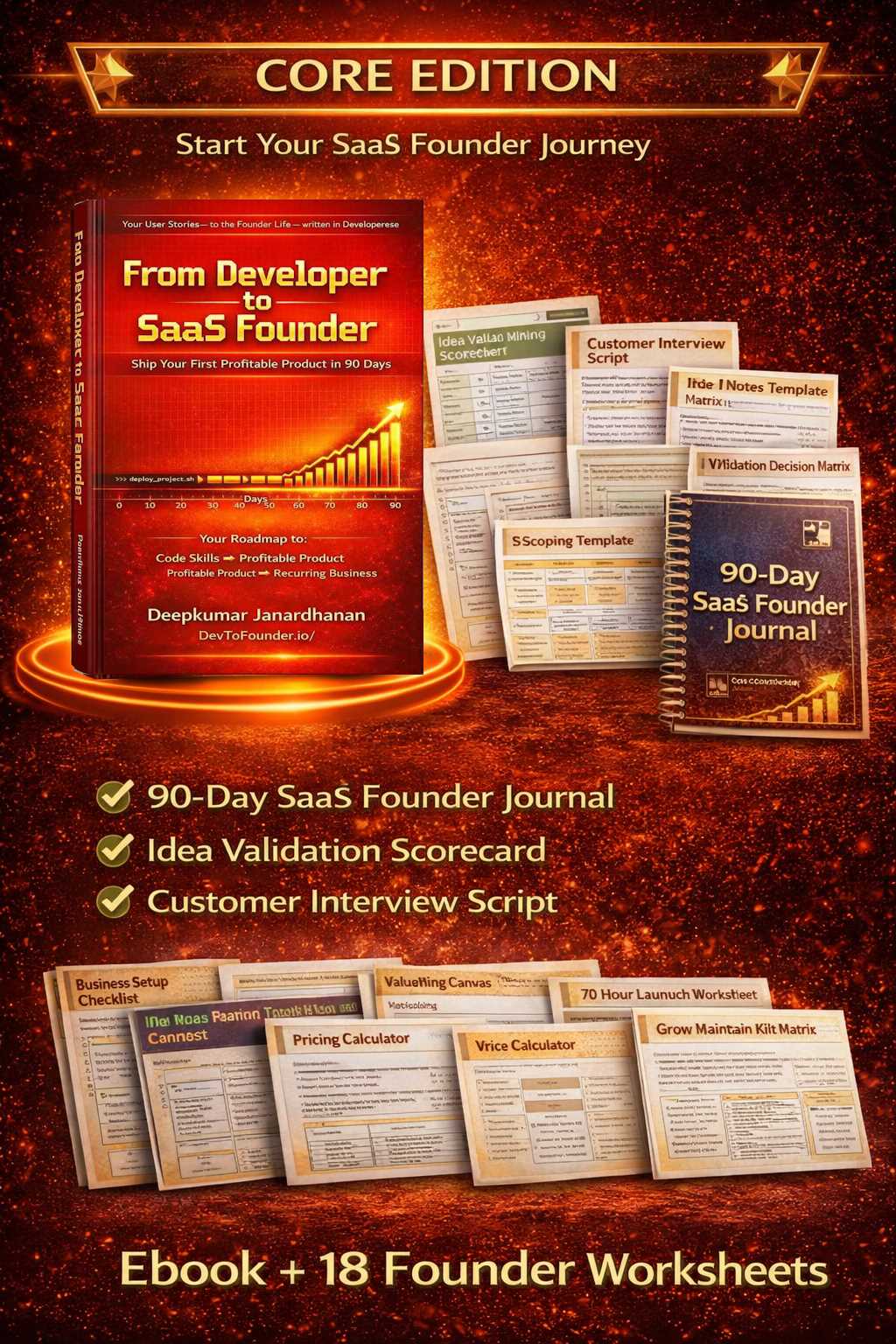
$69

Ideal if you prefer to execute independently.
For serious builders who want structure and tools.
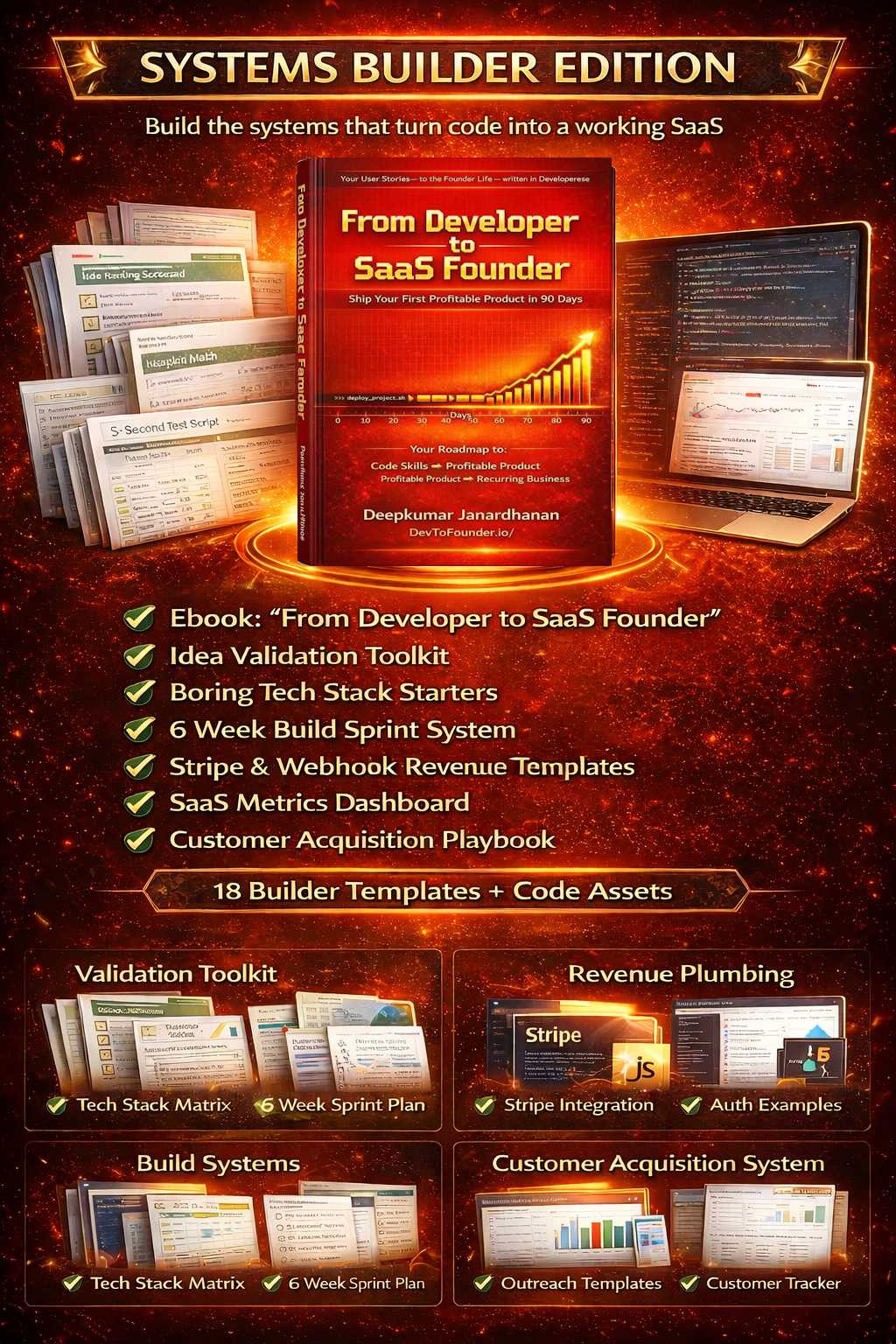
$129

Recommended if you want disciplined execution, not just theory.
Get Systems Builder - $97For builders planning multiple products.
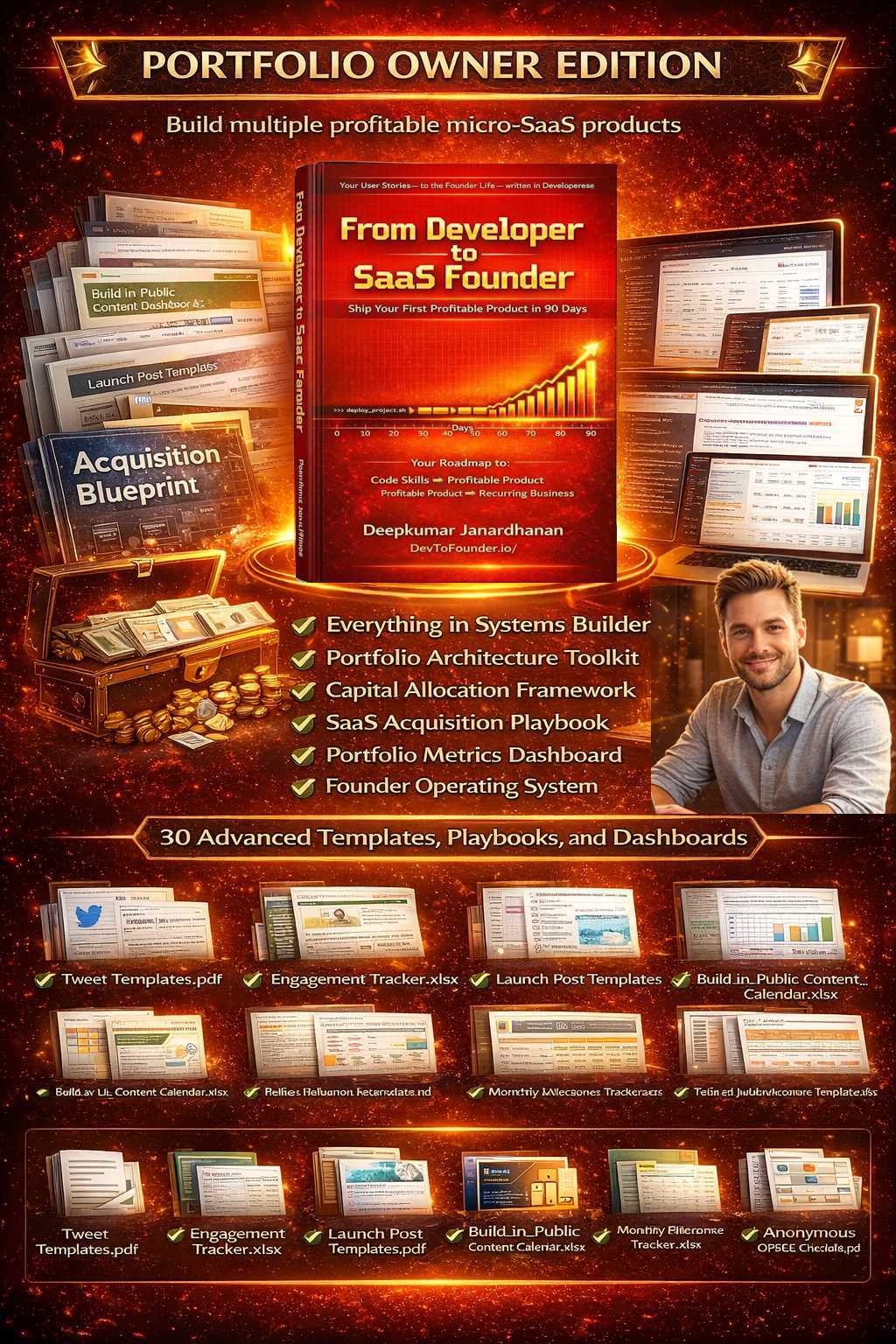
$199

Designed for long-term leverage and compounding.
Get Owner Edition - $147Just one failed 6-month side project costs more than any of these tiers.

Free Guide
Problem Mining for Developers — the condensed guide to finding the right SaaS problem before you write a line of code. Four chapters, one tracker template, zero fluff.
Get the free guide
No spam. Just the PDF.